

For decades, admission to India’s leading MBA programmes has been synonymous with highly competitive entrance examinations such as CAT, XAT, CMAT, MAT, SNAP, NMAT, and GMAT. Every year, hundreds of thousands of aspirants compete for a limited number of seats in prestigious business schools. The intense competition often creates the impression that a top-quality management education is impossible without securing an exceptional entrance-test score.
However, the reality is more nuanced. Several of India’s leading management institutions offer alternative admission pathways that place greater emphasis on academic achievements, professional experience, leadership potential, interviews, and holistic candidate evaluation rather than solely relying on competitive entrance examinations. These routes are commonly referred to as non-competitive admission pathways because they reduce dependence on highly competitive entrance-test rankings.
What Does Non-Competitive Admission Mean?
Non-competitive admission, in the context of MBA programmes in India, refers to admission processes that do not rely solely or primarily on national standardised entrance examinations such as CAT, MAT, XAT, or CMAT. Instead, these admissions may be based on one or more of the following criteria:
- Academic record and undergraduate CGPA or percentage
- Professional work experience and career trajectory
- Personal or telephonic interviews conducted by the institution
- Written ability tests or group discussions specific to the institution
- GMAT or GRE scores (predominantly for executive or international programmes)
- Research or industry portfolios
- Management aptitude assessed through institutional tests
- Sponsored or employer-nominated candidature
The term ‘non-competitive’ is somewhat relative, since admission to top-tier institutions through these routes is still selective and standards remain high. However, the evaluation is based on a more holistic and broader assessment of candidature rather than a single standardised test score.
Why Non-Competitive Routes Exist
Several compelling reasons explain the prevalence and growth of non-competitive MBA admissions in India. The growing need to cater to working professionals who cannot afford to devote months to entrance examination preparation while holding full-time jobs has been a major driver. Executive MBA (EMBA) and part-time MBA programmes, which target mid-career professionals, have naturally adopted more experience-based admission criteria.
Furthermore, many premier institutions recognise that a single examination score is an imperfect predictor of managerial success. Leadership potential, emotional intelligence, communication skills, and domain expertise are qualities that a multiple-choice test cannot adequately capture. By broadening their admission criteria, colleges can attract a more diverse and accomplished pool of candidates.
International collaborations and the globalization of management education have also played a role. Indian institutions with global partnerships or accreditations (AACSB, EQUIS, AMBA) often align with global admission standards, which typically place less emphasis on national standardised tests and more on GMAT or GRE scores and professional backgrounds.
Categories of Non-Competitive MBA Programmes in India
✦ Executive MBA (EMBA) Programmes
Executive MBA programmes are the most prominent category of non-competitive management education in India. Designed for professionals with typically five or more years of work experience, EMBA programmes priorities career achievements, leadership exposure, and professional growth over entrance examination scores. Admissions are commonly based on academic records, letters of recommendation, personal statements, and interviews.
Several IIMs, including IIM Calcutta, IIM Ahmedabad, IIM Bangalore, and IIM Kozhikode, offer EMBA or advanced management programmes that do not require CAT scores. Instead, they accept GMAT scores or evaluate candidates purely on professional credentials and interviews. The Indian School of Business (ISB) in Hyderabad and Mohali is a leading example of an institution where the one-year Post Graduate Programme in Management (PGP) relies on GMAT or GRE scores and extensive work experience rather than the CAT.
✦ PGDM and MBA Programmes Accepting GMAT or GRE
Several top private B-schools in India accept GMAT or GRE scores as an alternative to CAT or other national tests. These scores, originally designed for international admissions, are increasingly recognised by Indian institutions as a credible measure of analytical and verbal aptitude. SPJIMR (SP Jain Institute of Management and Research) in Mumbai, for instance, accepts GMAT scores for its PGDM programme. XLRI Jamshedpur accepts GMAT for its Business Management and Human Resource Management programmes in some categories.
✦ Part-Time MBA Programmes
Part-time MBA programmes are designed for working executives who wish to pursue management education without interrupting their careers. These programmes, often held on weekends or evenings, typically have more flexible admission criteria. NMIMS Mumbai, Symbiosis Institute of Business Management (SIBM), and several other institutions offer part-time MBA pathways where work experience and academic background carry significant weight in the admission process.
✦ Distance and Online MBA Programmes
With the rise of digital education, online and distance MBA programmes from accredited institutions have gained considerable legitimacy. IGNOU (Indira Gandhi National Open University) offers an MBA programme through distance mode with admission based on a simple entrance test that is far less competitive than CAT. Symbiosis Centre for Distance Learning (SCDL), Amity University Online, and several IIM-affiliated online programmes now offer management education with minimal or no competitive entrance requirements.
✦ Institutional Direct Admission Routes
Some institutions maintain a portion of their MBA seats for direct admission based on academic excellence, diversity quotas, or specific professional backgrounds. Management institutions under various universities may admit students based on the marks obtained in qualifying examinations rather than a separate entrance test. NRI quotas, international student categories, and management quotas are other examples of admission routes that circumvent standard competitive examinations.
Top MBA Colleges Offering Non-Competitive Admissions
| Institute | Programme | Admission Route (Without CAT) | Eligibility / Selection Criteria |
| Indian School of Business | PGP (1-Year MBA Equivalent) | GMAT/GRE | Academic record, essays, recommendations, interview, work experience preferred |
| IIM Calcutta | PGPEX | GMAT | Minimum 5 years work experience, interview |
| IIM Bangalore | EPGP | GMAT | Work experience, academic profile, leadership assessment |
| IIM Ahmedabad | PGPX | GMAT | Minimum 5 years experience, academics, interview |
| IIM Kozhikode | EPGP / IIMK LIVE | GMAT or Professional Profile | Professional credentials and interview |
| SP Jain Institute of Management and Research | PGPM / PGMPW | GMAT | Work experience, academics, written test, interview |
| XLRI Jamshedpur | GMP | GMAT | Experienced professionals, interview |
| Management Development Institute | GMP / NMP | Profile-Based Admission | Professional achievements, academics, interview |
| Great Lakes Institute of Management | PGPM | GMAT/GRE | Academic profile, work experience, interview |
| Symbiosis Institute of Business Management | MBA Programmes | SNAP Examination | SNAP score, GD-PI process |
| NMIMS School of Business Management | MBA / MBA for Working Executives | NMAT | NMAT score or profile-based interview for executive programmes |
| Tata Institute of Social Sciences | HRM & Labour Relations / Professional Programmes | TISS Admission Process | Academic record, interviews, case discussions |
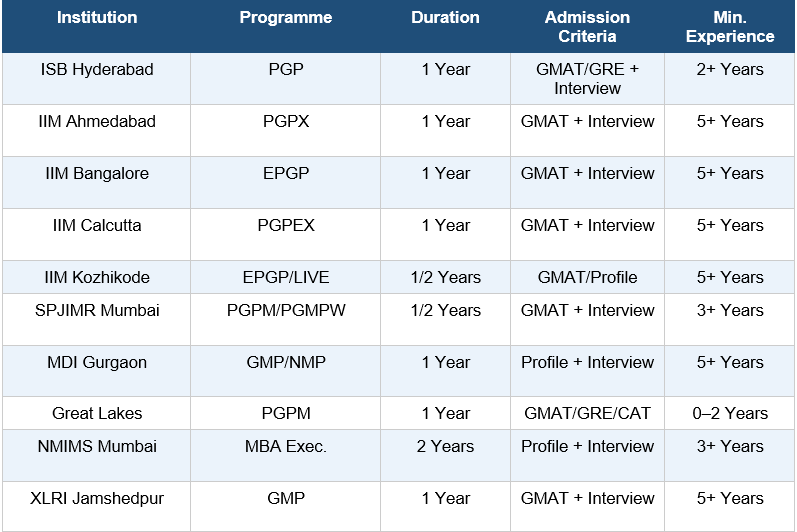
Comparative Overview of Top Non-Competitive MBA Programmes
The following table provides a comparative snapshot of leading non-competitive MBA options in India:
Direct Admission Through Institutional Quota
Several private universities offer institutional admission pathways commonly referred to as management quota admissions.
These seats are generally available in:
- Private universities
- Deemed universities
- Autonomous institutions
The admission process typically includes:
- Application submission
- Academic review
- Personal interview
- Document verification
- Fee payment
Many institutions prioritize candidates demonstrating strong academic backgrounds and genuine interest in management education.
Eligibility Criteria for Non-Competitive MBA Admission
Requirements vary across institutions but generally include:
| Eligibility Criteria | Requirement | Details |
|---|
| Academic Qualification | Bachelor’s Degree | Candidates must hold a bachelor’s degree from a recognized university in any discipline. |
| Minimum Marks | 50%–60% Aggregate | Most institutions require a minimum aggregate score ranging between 50% and 60% in graduation, depending on the programme and institution. |
| Work Experience | Professional Experience | Executive MBA programmes generally prefer candidates with prior work experience. Requirements vary by programme level. |
| Minimum Experience | 2+ Years | Entry-level executive programmes typically require at least two years of full-time professional experience. |
| Average Experience Profile | 4–8 Years | Most admitted candidates in executive MBA programmes possess between four and eight years of work experience. |
| Senior Executive Programmes | 5+ Years | Premium programmes at leading institutions often require five or more years of managerial or professional experience. |
| Communication Skills | Verbal & Written Proficiency | Strong communication abilities are essential for interviews, group discussions, classroom participation, and leadership roles. |
| Leadership Potential | Demonstrated Initiative | Admissions committees evaluate evidence of leadership, responsibility, decision-making, teamwork, and professional accomplishments. |
Direct MBA Admissions Process 2026
The process for MBA admissions without entrance exams is relatively simple and does not involve many stages. Although the direct admission process to MBA colleges is very similar to the regular admission process but it takes less time as there is no need to take the entrance test. Check out the direct MBA admission process below:
Step 1: Register for the MBA programme at the desired MBA college by filling out the MBA application form
Step 2: Submit the required documents and the application form along with the required application fee
Step 3: Submit the SoP if it is a necessary document for direct MBA admission 2026
Step 4: Candidates who have been shortlisted by their desired college should appear for the GD-PI-WAT rounds to get admission to the MBA programme as required
Step 5: If the candidate is selected after the GD/PI rounds, they will receive the final admission offer letter and will be required to pay the acceptance fee
Documents Required for Direct Admission to MBA in India in 2026
The candidates should carry the following list of documents if they wish to take direct admission to the MBA programme:
- Graduation mark sheet or provisional certificate
- Class 12 mark sheet
- Class 10 mark sheet
- Photo ID proof issued by the Government of India
- Transfer certificate
- Passport-size photographs
Career Opportunities After Non-Competitive MBA Programmes
| Career Outcomes | Details |
|---|---|
| Consulting | Graduates frequently secure roles in management consulting, business consulting, strategy consulting, and advisory services. |
| Product Management | Opportunities include product manager, product analyst, and product strategy roles across technology and consumer-focused companies. |
| Strategy | MBA graduates often work in corporate strategy, business planning, growth strategy, and strategic consulting functions. |
| Operations | Careers include operations management, supply chain management, logistics, and process improvement roles. |
| Finance | Popular roles include financial analyst, investment analyst, corporate finance manager, risk analyst, and banking professional. |
| Marketing | Graduates pursue careers in brand management, digital marketing, market research, sales management, and marketing strategy. |
| Analytics | Opportunities exist in business analytics, data analytics, market intelligence, and decision-support functions. |
| Human Resources | HR graduates work in talent acquisition, employee relations, compensation and benefits, learning and development, and HR consulting. |
| Entrepreneurship | Many graduates launch startups, expand family businesses, or become business founders and entrepreneurs. |
Advantages of Non-Competitive MBA Admission
✧ Reduced Exam Pressure
Candidates avoid the uncertainty associated with highly competitive entrance tests.
✧ Holistic Evaluation
Institutions assess the complete profile rather than a single score.
✧ Better Fit for Professionals
Experienced candidates can showcase real-world accomplishments.
✧ Faster Career Progression
Executive MBA graduates often return to industry with enhanced managerial capabilities.
✧ Strong Networking
Programs attract experienced professionals, creating valuable peer-learning opportunities.
Conclusion
Choosing from the best MBA Colleges Without Entrance Exam in India allows students to build a successful management career without facing competitive entrance tests.. Many reputable schools offer top-quality education through direct admission. A listing of MBA Colleges Without Entrance Exam in India offers excellent opportunities for students looking to make a name for themselves in management with no exam pressure.
With a variety of eligibility options, easy admissions procedures, and various learning styles, an MBA without an entrance exam is a viable option for a lot of students. But proper research is crucial prior to choosing the appropriate college. Be sure to verify approvals, faculty, and support for placement.
Read More Blogs-
- Direct Admission in Top MBA Colleges in Indore 2026
- Direct Admission in Top MBA Colleges in Pune 2026
- Direct Admission in Top MBA Colleges in Delhi 2026
- Direct Admission in Top MBA Colleges in Hyderabad 2026
- PGDM Admission under Management Quota in India’s Top B-Schools
- Top MBA College Accepting SNAP Low Score Direct Admission
- Top MBA Colleges in Bangalore Accepting CAT Low Score 2026 Direct Admission
- Top MBA Colleges in Mumbai Accepting CAT 2026 score Direct Admission
- Top MBA Colleges in Delhi NCR Accepting CAT Low Score 2026 Direct Admission
- Direct MBA Admission without CAT
- List of MBA Colleges Accepting 50-70 Percentile CAT Get Direct Admission
- Top MBA Colleges Accepting 50-60 Percentile in CAT Exam- Direct Admission
- Top MBA Colleges Accepting 80-90 Percentile in CAT Exam- Direct Admission
- Low Rank/Score in CAT? Get Direct MBA Admissions in Top Colleges
- Top MBA Colleges Accepting 60-70 Percentile in CAT Exam Direct Admission
- Top MBA Colleges Accepting 70-80 Percentile CAT Exam- Direct Admission
- Direct Admission in Top MBA Colleges of Metropolitan City Delhi NCR
- Does ISB Hyderabad has Management Quota Seats
- Get Direct Admission in Symbiosis Pune
- Direct Admission in NMIMS Mumbai for MBA
- Welingkar Management Quota | Direct Admission | Call @ 9742479101
- Direct Admission in MDI Gurgoan Management Quota Seats
- Direct Admission in IMT Ghaziabad Low Score via Management Quota
- Direct Admission in Top MBA Colleges Across