


The Management Quota Reality Check
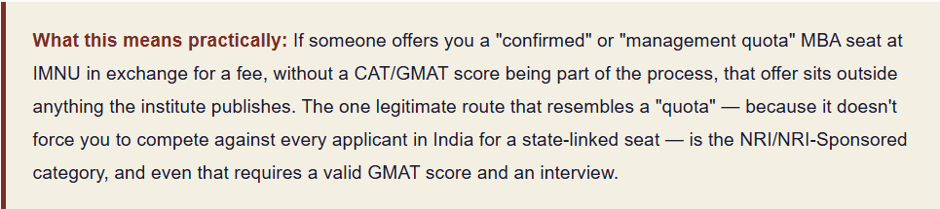
Start with the plain fact: the MBA admission process at the Institute of Management, Nirma University is based primarily on CAT scores with a minimum percentile requirement, and there is no mention of direct or management quota admissions in the institute’s own selection process. GMAT is accepted only for a defined NRI-linked category, not as a parallel purchase-a-seat route.
Compare that with how IMNU’s own engineering wing operates. On the BTech side, Nirma University does run an actual, named management quota, governed by Gujarat government rules, with a defined seat intake and a published fee — currently around ₹8.93 lakh for the engineering management quota route. The MBA program has no equivalent structure. That distinction matters, because a large share of the “Nirma MBA management quota” content online is written by people who are quietly repurposing the engineering-quota template for a program that doesn’t offer it.
Seat Matrix: General, Gujarat, and NRI
The flagship two-year MBA program carries a total intake of 300 seats, split three ways. The program has a total of 300 seats: 180 General, 45 NRI/NRI Sponsored, and 75 Gujarat State Quota, with candidates from Gujarat eligible to apply to both categories. On top of the base 300, an additional 15% supernumerary allocation exists for two sub-categories: children of parents currently working in Gulf countries or South-East Asia (CIWGC-SEA, 5% of seats), and Overseas Citizens of India or Foreign Nationals holding non-Indian passports (OCI/PIO/FN).
IMNU MBA 2026-27: Seat Distribution by Category (Base Intake: 300)
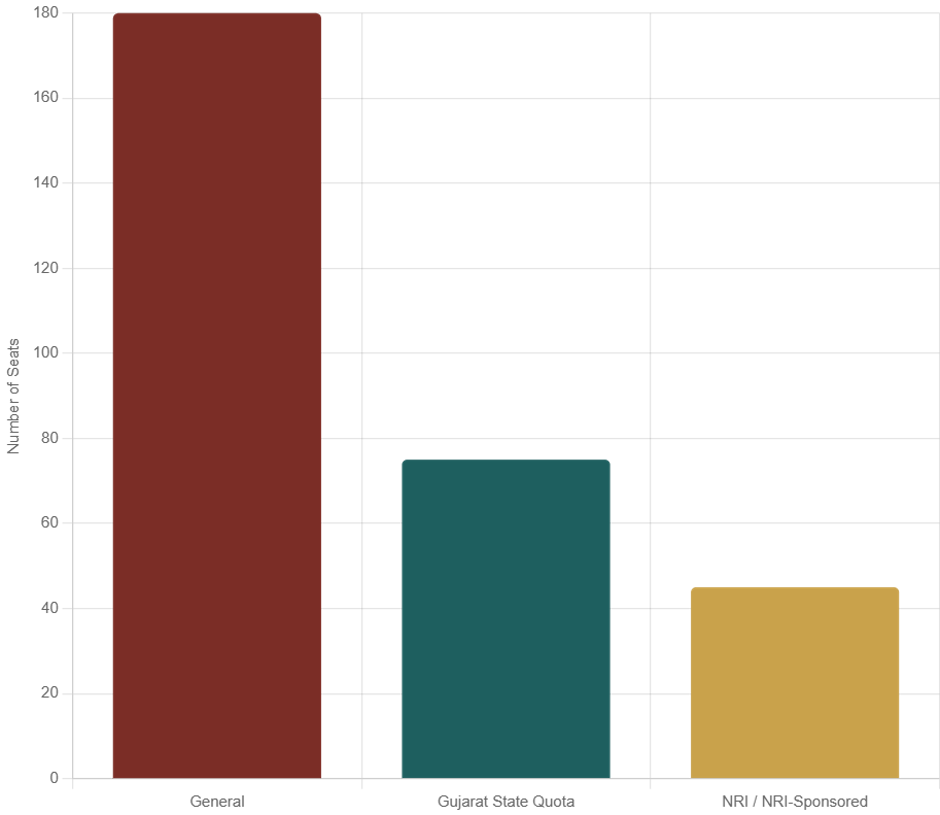
A separate, smaller batch of 30 seats runs the MBA-HRM program, and both figures appear consistently across the institute’s own admissions pages and third-party trackers reporting the 2026 cycle.
| Admission Aspect | Details | Impact on Applicants |
|---|---|---|
| Gujarat State Quota (75 Seats) | These 75 seats are allotted through the ACPC (Admission Committee for Professional Courses), Gujarat counselling process and are not filled directly by IMNU. | Gujarat-domiciled candidates effectively have two opportunities for admission: they can compete for the 75 Gujarat State Quota seats through ACPC as well as the 180 General Category seats through the regular admission process. |
| General Category (180 Seats) | Open to eligible applicants from across India based on the institute’s admission criteria. | Gujarat candidates are also eligible to compete in this category, improving their overall chances of selection. |
| Supernumerary Seats (15%) | The 15% CIWGC-SEA and OCI/PIO/Foreign National (FN) allocation is supernumerary, meaning these seats are in addition to the regular intake of 300 seats. | The institute’s effective intake for a typical admission cycle increases from the headline 300 seats to approximately 345 seats after including these additional categories. |
| Total Effective Intake | Base intake: 300 seats + Supernumerary allocation (approximately 45 seats). | Applicants from eligible international categories compete for seats outside the regular sanctioned intake, without reducing the number of standard seats. |
| Admission Requirement Across All Categories | Regardless of the admission category—General, Gujarat State Quota, or Supernumerary—every applicant must satisfy the institute’s admission process. | No category provides direct admission without merit. A valid entrance examination score and successful performance in the Personal Interview (PI) (and any other prescribed selection stages) remain mandatory for admission. |
Eligibility Criteria
All India Categories (65%):
- 65% of absolute admission will be filled from the applicants who have finished the passing assessment from schools situated in India (counting Gujarat State) and have shown up for UGAT for the related scholastic year.
- Applicants must have passed their Higher Secondary Certificate (HSC)/(10+2) Examination or some other proportional assessment perceived by NIRMA University with at least 60% total imprints with English as one of the subjects.
- Above 20 years age of student will not be eligible for in five years BBA-MBA integrated program.
Gujarat State category (20%):
- 20% of the complete admission will be filled from the competitors who have breezed through the passing assessment from the schools situated in the State of Gujarat.
- Competitors ought to have passed Higher Secondary Certificate (HSC)/(10+2) Examination or some other comparable assessment perceived by Nirma University with least 90% total imprints with first endeavor and English as one of the subjects.
- Above 20 years age of student will not be eligible for in five years BBA-MBA integrated program.
NRI Category (15%):
15% of the complete admission will be filled by Institute of Management, Nirma University with following qualification criteria.
For NRI Candidates:
- Candidate must have passed their 10+2 from abroad with minimum of 60% aggregate marks.
- Above 20 years age of student will not be eligible for in five years BBA-MBA integrated program.
- Candidate will have to produce equivalence certificate of qualifying examination from Association of Indian Universities (AIU), New Delhi.
- If you are interested in NRI quota and have NRI status then there are several other option available for you – which include Welingkar NRI quota for MBA and IMT NRI quota seats.
How Selection Actually Works
The admission funnel has four stages, and none of them can be skipped by payment:
✦ Entrance score: CAT for Indian General and Gujarat-category candidates; GMAT for NRI/PIO/FN/OCI applicants; NRI-Sponsored candidates must still sit the CAT.
✦ Preliminary shortlisting: based on CAT or GMAT scores, with the institute also weighing academic performance, work experience, and extracurricular achievements at this stage.
✦ Theme Development & Presentation (TDP): candidates present analysis on a given theme, assessed on creativity, critical thinking, and communication.
✦ Personal Interview (PI): evaluates self-awareness, leadership potential, social awareness, and suitability for management education.
IMNU MBA Final Selection: Composite Score Weightage
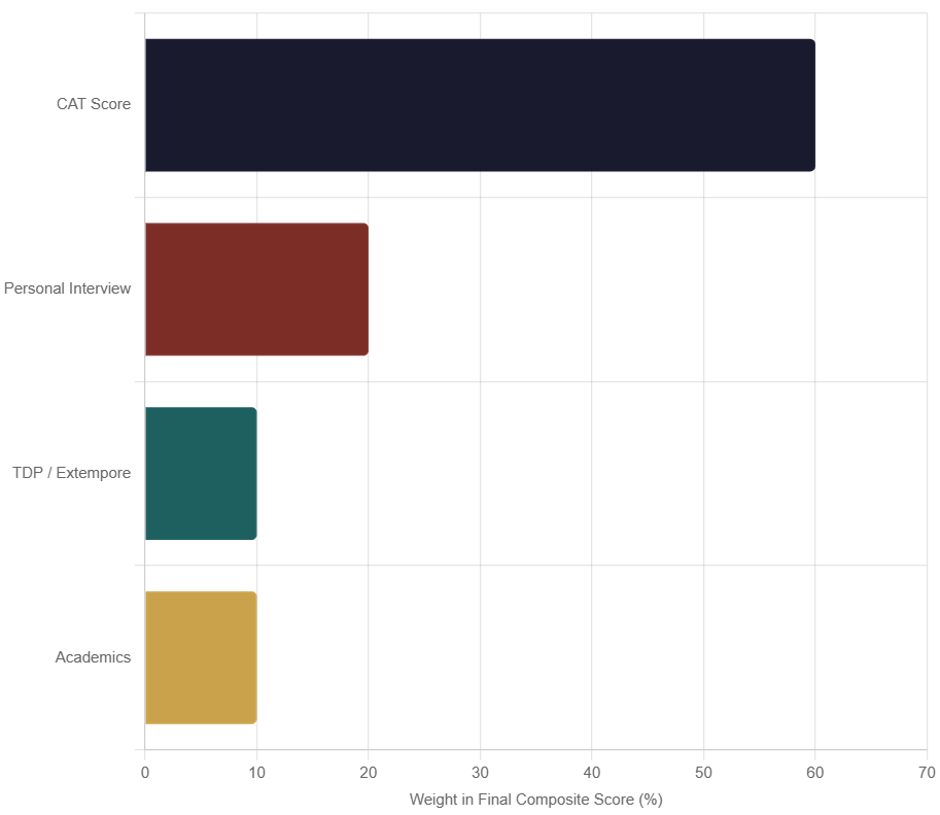
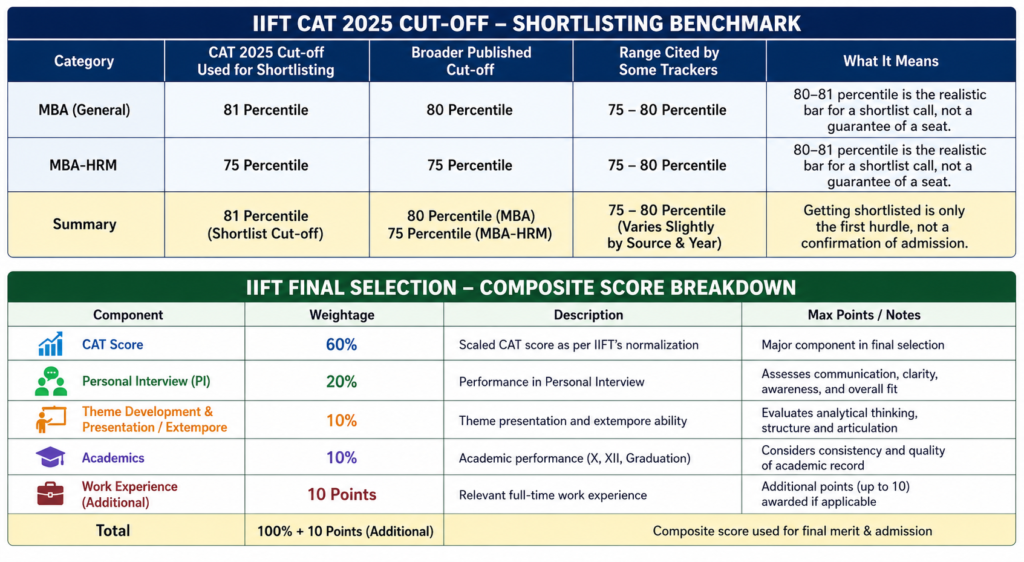
This is worth sitting with. A candidate who clears the 81-percentile cutoff but performs poorly in the TDP and PI can still be denied a seat, because those two rounds together account for 30% of the final score — nearly half the weight of CAT itself. No fee, donation, or “quota” bypasses this composite calculation; it is applied uniformly across the General and Gujarat categories.
CAT/GMAT Cutoffs and the Composite Scoring Formula
Fee Structure Across Categories
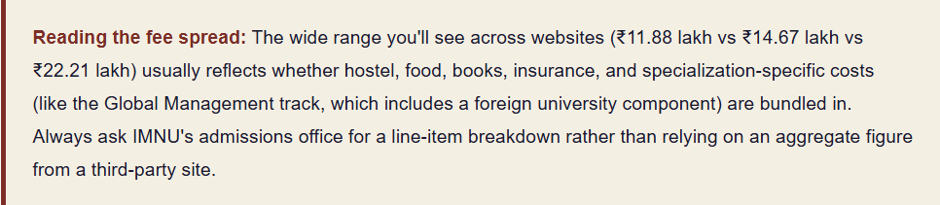
Fees vary meaningfully by category and by which third-party source is quoting the figure — a common source of confusion in this space, since IMNU periodically revises tuition and trackers update on different schedules. Below is the most current published range for the 2026-27 flagship MBA program.
| Category | Annual Tuition | 2-Year Total (approx.) | Notes |
| General (India) | ₹7,07,500 | ₹14.15 lakh | Plus ₹15,000/yr activity fee, ₹11,000/yr exam fee |
| NRI / NRI-Sponsored / PIO / FN | US$15,250 | ~US$30,500 | Some trackers report full cost (with hostel, exam fees) at ₹27–29.4 lakh |
| MBA-HRM (General) | ~₹6.4 lakh | ~₹12.8 lakh | Separate 30-seat program |
The annual tuition fee for 2026-27 is ₹7,07,500, bringing total tuition across the two years to ₹14,15,000, with an Activity Fee of ₹15,000 per annum and an Examination Fee of ₹11,000 per annum layered on top. Hostel accommodation runs roughly ₹94,400 plus GST per year for non-AC twin-sharing, and the institute strongly recommends residence since it is a fully residential program. For a realistic all-in figure, independent aggregator estimates place total General-category MBA cost, including hostel and other components, in the ₹11.88–22.21 lakh range depending on specialization, while NRI-category totals run ₹27–29.41 lakh.
The NRI/NRI-Sponsored Route, Explained Properly
This is the category most often mislabelled as “management quota,” and it deserves a precise explanation because it genuinely does offer a different — and less competitive — pathway than the General category.
Two sub-types exist:
NRI (self-status): The applicant themselves holds NRI status. GMAT is accepted in place of CAT.
NRI-Sponsored: An Indian resident candidate is sponsored by a relative or guardian with verified NRI status, who undertakes to pay the full tuition and fees for the program. The sponsoring NRI must provide a sponsorship letter along with an undertaking to pay all tuition and other fees for the entire course, plus documentary evidence of their NRI status. Crucially, for NRI-Sponsored candidates specifically, only CAT scores are considered — not GMAT.
The admission application fee for the NRI-Sponsored category is ₹4,500, compared to ₹1,500 for General category candidates, and NRI General category applicants pay ₹6,000.
Gujarat State Quota via ACPC
The 75-seat Gujarat State Quota is filled through the Admission Committee for Professional Courses (ACPC), the Gujarat government’s centralized counselling body — not through direct application to IMNU. Gujarat-domiciled candidates retain the option to apply under both the Gujarat quota and the General/All-India category simultaneously, which meaningfully improves their odds relative to an out-of-state applicant competing only for the 180 General seats.
Placement Context: What the Fee Is Actually Buying
Since the NRI-category fee runs roughly double the General category on a per-year basis, it’s worth grounding the decision in what the program delivers on the other end. IMNU is accredited with NAAC A+ grade, holds AACSB membership, and has been ranked 55th overall by NIRF 2024. On sector-specific rankings, the institute was ranked 8th among the top 50 B-schools under the university program category by IIRF 2024, and 5th Best Private B-School pan-India by Business Standard in 2023, while a separate ranking placed it 10th out of 122 colleges in India by IIRF in 2025, an improvement from 17th out of 110 colleges in 2024.

On placements, the program cites a highest package of ₹70 LPA, and recruiter lists across sources mention a consistent set of names — Morgan Stanley, Google, Ernst & Young, J.P. Morgan Chase & Co., Infosys, Wipro, Tata group companies, Deloitte, Mahindra Group, Capgemini, SAP, Unilever, Alkem, and ICICI among recent recruiters. The program markets a 100% placement record for the 2023-24 batch, though as with any single-institute placement claim, prospective students should ask for batch-wise average and median packages (not just the ceiling figure) when evaluating return on the ₹14–30 lakh investment.
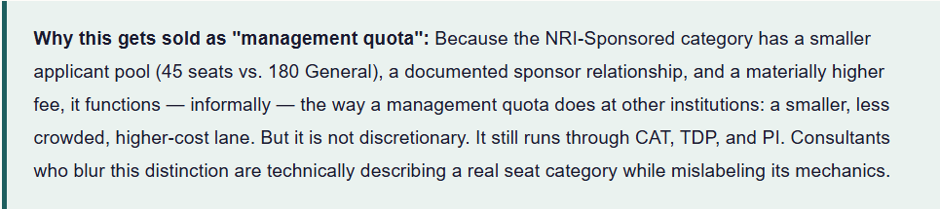
The point of grounding fees against outcomes here isn’t to validate or challenge IMNU’s placement claims — it’s to reframe the “management quota” question correctly. Because no discretionary seat exists, the fee differential between General and NRI categories isn’t buying preferential admission odds; both categories go through the same TDP/PI evaluation. What the NRI/NRI-Sponsored fee is actually buying is access to a smaller, less crowded 45-seat applicant pool, and — for genuinely NRI-linked families — a legitimate documentation-based pathway rather than a competitive one.
Why Consultants Keep Selling “Management Quota”
A cluster of education-consultancy sites actively markets “direct admission” and “management quota” access to IMNU’s MBA program, often alongside similar claims for IIM Rohtak, MDI Gurgaon, and IMT Ghaziabad in the same paragraph. One such site explicitly states that admission through the “management quota” is based on merit and at the discretion of the institute’s management, and separately invites students to check eligibility for “NIRMA management quota seats” via phone consultation — language IMNU’s own admissions material does not use anywhere for the MBA program.
The more careful counselling sites are direct about this gap. One admissions guidance platform states plainly that Nirma does not openly advertise a management quota, and that all seats are filled based on merit and selection criteria mentioned in the official prospectus — while still fielding the same recurring question from anxious applicants: whether a genuine “NIRMA University direct admission” or “management quota admission route” exists, a doubt the platform attributes to terms being frequently misused by agents and middlemen.
Other IMNU Programs and Their Entry Routes
| Program | Entry Route | Seats | Fee (approx., total) |
| MBA (Flagship) | CAT/GMAT + TDP + PI | 300 | ₹14.15L (Gen) / $30.5K (NRI) |
| MBA-HRM | CAT/GMAT + TDP + PI | 30 | ~₹12.8L |
| MBA (Family Business & Entrepreneurship) | IMNU-conducted entrance test + PI | 60 | ~₹11.88L (₹5.12L/yr tuition) |
| Integrated BBA-MBA (5-year) | IPMAT + PI | 240 (156 AI / 48 Guj / 36 NRI) | ₹19.45L (Gen) / ~$33.25K (NRI) |
| BTech + MBA (5-year) | JEE Main + Academics + PI | ~120 | ₹25.56L |
The Family Business & Entrepreneurship MBA charges ₹5,12,000 per annum in tuition plus an ₹11,000 examination fee, against a total intake of 60 seats, with selection via an IMNU-conducted entrance test rather than CAT. This is the one legitimate program at IMNU where the admission logic (test conducted by the institute itself, smaller applicant pool, entrepreneurial-family profile expected) most resembles what people colloquially mean by “quota” — and it, too, is entrance-test-gated rather than fee-gated.
What Actually Improves Your Odds, Given This Structure
Since no fee-based shortcut exists, the practical path to an IMNU MBA seat runs through the same three levers every applicant controls directly:
✧ CAT preparation, treated as the 60% lever it is. Because CAT score dominates the composite formula, marginal improvement here has outsized impact relative to marginal improvement in PI performance. An applicant sitting at 75th percentile should generally prioritize closing that gap toward 80–81 before over-investing in interview coaching.
✧ TDP and PI preparation, treated as the 30% combined lever. Once shortlisted, the gap between candidates often narrows enough that TDP and PI performance becomes the deciding factor. IMNU’s PI evaluates self-awareness and leadership potential specifically — generic interview scripts tend to underperform against candidates who can speak concretely about their own decisions and trade-offs.
✧ Work experience, worth up to 10 bonus points. Candidates with relevant full-time professional experience should ensure this is clearly documented and quantified in their application, since it’s an explicit scoring component rather than a soft factor considered informally.
✧ For NRI-Sponsored applicants specifically: the sponsorship documentation (proof of NRI status, sponsorship letter, payment undertaking) should be prepared well before the application deadline, since incomplete documentation is a more common cause of delay in this category than in General or Gujarat-quota applications.
Frequently Asked Questions
Does IMNU have a genuine management quota for its MBA program?
No. Every seat category — General, Gujarat State Quota, and NRI/NRI-Sponsored — requires a CAT or GMAT score followed by TDP and PI. There is no discretionary, fee-only admission route published by the institute.
What’s the closest legitimate alternative to a “management quota” seat?
The NRI-Sponsored category, where an NRI relative sponsors your fees and you’re evaluated within a smaller 45-seat pool — but you still need a CAT score and must clear TDP and PI.
What CAT percentile is realistically needed?
Aim for 80+ percentile to clear the shortlisting stage; recent cycles have used cutoffs between 80 and 81 percentile. Treat this as a shortlisting threshold, not a seat guarantee — final admission depends on the full composite score.
Can a low CAT score be offset by a strong PI performance?
Partially. CAT carries 60% weight in the final composite score, so a very low CAT score is difficult to fully offset, but the 20% PI and 10% TDP weightage mean interview performance matters substantially once shortlisted.
Is the Family Business & Entrepreneurship MBA easier to get into?
It uses a separate, IMNU-conducted entrance test rather than CAT, and targets a specific applicant profile (candidates with family business backgrounds), but it is not fee-based or discretionary either.
Can a Gujarat-domiciled candidate apply to both the General and Gujarat State Quota categories?
Yes. Gujarat candidates can apply under both, which improves their overall odds relative to applicants who qualify only for the 180 General seats.
Does a higher fee under the NRI category buy a lower entrance bar?
No published evidence supports this. The NRI category has a smaller seat pool and a different fee structure, but the same TDP/PI evaluation and a CAT or GMAT score requirement apply.
Where should applicants verify current fees and cutoffs before committing?
Directly with IMNU’s admissions office or its official portal (admissions.nirmauni.ac.in), since fee structures are revised annually and third-party aggregator figures can lag behind the current cycle.
Read More Blogs-
- Direct Admission in Top MBA Colleges in Hyderabad 2026
- PGDM Admission under Management Quota in India’s Top B-Schools
- Top MBA College Accepting SNAP Low Score Direct Admission
- Top MBA Colleges in Bangalore Accepting CAT Low Score 2026 Direct Admission
- Top MBA Colleges in Mumbai Accepting CAT 2026 score Direct Admission
- Top MBA Colleges in Delhi NCR Accepting CAT Low Score 2026 Direct Admission
- Direct MBA Admission without CAT
- List of MBA Colleges Accepting 50-70 Percentile CAT Get Direct Admission
- Top MBA Colleges Accepting 50-60 Percentile in CAT Exam- Direct Admission
- Top MBA Colleges Accepting 80-90 Percentile in CAT Exam- Direct Admission
- Low Rank/Score in CAT? Get Direct MBA Admissions in Top Colleges
- Top MBA Colleges Accepting 60-70 Percentile in CAT Exam Direct Admission
- Top MBA Colleges Accepting 70-80 Percentile CAT Exam- Direct Admission
- Direct Admission in Top MBA Colleges of Metropolitan City Delhi NCR
- Does ISB Hyderabad has Management Quota Seats
- Get Direct Admission in Symbiosis Pune
- Direct Admission in NMIMS Mumbai for MBA
- Welingkar Management Quota | Direct Admission | Call @ 9742479101
- Direct Admission in MDI Gurgoan Management Quota Seats
- Direct Admission in IMT Ghaziabad Low Score via Management Quota
- Direct Admission in Top MBA Colleges Across