


What Is Management Quota? The Regulatory and Institutional Framework
Every year, lakhs of MBA aspirants sit for CAT, XAT, SNAP, CMAT, and MAT — the entrance examinations that ostensibly determine who walks through the doors of India’s most coveted business schools. Yet a parallel and entirely legal admission pathway exists, one that is less publicised but equally significant: management quota admission, sometimes called institutional quota or discretionary quota.
Under guidelines issued by the All India Council for Technical Education (AICTE) and affirmed by the Supreme Court’s T.M.A. Pai Foundation judgment, private unaided professional institutions have the right to fill a defined proportion of their seats through their own admission processes. For MBA programmes, this proportion typically ranges from 15% to 25% of sanctioned intake, depending on the state government’s higher education policy and the institution’s affiliation conditions.
This means that in a college with 240 MBA seats, between 36 and 60 seats are available outside the centralized state-level merit counselling process. Institutions may fill these seats by conducting their own eligibility screening, conducting personal interviews, or through direct applications, often at a higher fee than the merit-route seats. Crucially, this pathway does not bar academically strong students — many high-scoring aspirants use it precisely to secure preferred institutions when state quota counselling yields less desirable options.
✦ AICTE: Grants approval for MBA programmes and sets the framework for fee regulation, intake, and quota allocation. Annual inspection and E-approval system govern seat matrix.
✦ State Governments / CETs: Many states (Maharashtra, Karnataka, Tamil Nadu, UP, etc.) conduct state-level MBA entrance exams and centralised counselling for state quota seats. Institutions must surrender 50–85% of seats to this process.
✦ NAAC & NBA: Accreditation bodies whose grades influence an institution’s fee cap and reputational standing. A+ and A++ NAAC grades typically indicate stronger placement infrastructure.
✦ University Affiliates: Deemed, private, and state university affiliates impose their own eligibility conditions layered on top of AICTE norms.
Top MBA Colleges Offering Management Quota Direct Admission in 2026
The following institutions represent India’s most sought-after B-schools where management quota and direct admission routes are available and well-established. Rankings draw from NIRF 2025, QS Asia rankings, and average CTC data from placement reports.
Tier-1: Premier Private B-Schools (NIRF Top 30)
These institutions hold the highest placement records and brand equity. Management quota seats in this tier are finite and in high demand — early inquiry (typically April–June for July batch starts) is essential.
| Institution | Location | Mgmt Quota Seats | Approx. Total Fee (₹) | Avg. CTC (LPA) | Key Exams Considered |
|---|---|---|---|---|---|
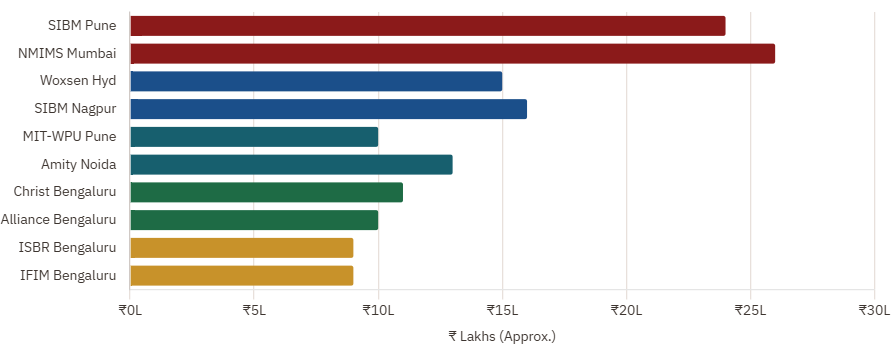
| SIBM Pune (Symbiosis) NAAC A++ | Pune, Maharashtra | ~30–36 | ₹22–26 L | ₹21–24 LPA | SNAP (relaxed cut-off) |
| Christ University MBA NAAC A+ | Bengaluru, Karnataka | ~40–60 | ₹9–12 L | ₹8–12 LPA | CUMAT / CAT / MAT |
| NMIMS Mumbai (PGDM) Deemed | Mumbai, Maharashtra | ~24–36 | ₹24–28 L | ₹18–22 LPA | NMAT by GMAC |
| Amity Business School NAAC A+ | Noida, UP | ~60–80 | ₹10–16 L | ₹7–10 LPA | CAT / MAT / GMAT / Own Test |
| SIBM Nagpur NAAC A | Nagpur, Maharashtra | ~30–42 | ₹14–18 L | ₹9–13 LPA | SNAP (relaxed cut-off) |
| Presidency Business School | Bengaluru, Karnataka | ~40–50 | ₹6–9 L | ₹6–9 LPA | CAT / MAT / KMAT |
| Alliance School of Business NAAC A+ | Bengaluru, Karnataka | ~35–50 | ₹8–11 L | ₹8–12 LPA | CAT / MAT / Alliance Entrance |
| ISBR Business School | Bengaluru, Karnataka | ~40–60 | ₹7–10 L | ₹6–9 LPA | CAT / MAT / KMAT / Own |
| Woxsen University NAAC A | Hyderabad, Telangana | ~30–45 | ₹12–17 L | ₹10–15 LPA | CAT / GMAT / Own Entrance |
| MIT-WPU (MIT School of Business) NAAC A+ | Pune, Maharashtra | ~40–55 | ₹8–12 L | ₹7–10 LPA | MAH-CET / CAT / MAT |
Tier-2: Strong Regional B-Schools with Robust Placements
These colleges may not appear in NIRF’s top 30 nationally, but hold strong domain-specific or regional brand recognition and consistent placement records in the ₹6–12 LPA range. Management quota seats here are comparatively easier to secure, with moderate fee structures.
| Institution | Location | Approx. Fee (₹) | Avg. CTC (LPA) | Specialisation Strength |
|---|---|---|---|---|
| IFIM Business School | Bengaluru | ₹8–10 L | ₹7–9 LPA | Finance, Analytics |
| Indus Business Academy | Bengaluru / Greater Noida | ₹5–8 L | ₹5–7 LPA | Marketing, HR |
| SIES College of Management | Mumbai | ₹5–7 L | ₹6–8 LPA | Operations, Finance |
| ITM Business School NBA | Mumbai / Navi Mumbai | ₹6–9 L | ₹6–9 LPA | International Business |
| IIHMR University | Jaipur, Rajasthan | ₹7–9 L | ₹6–8 LPA | Hospital & Health Mgmt |
| St. Joseph’s Institute of Management | Bengaluru | ₹4–6 L | ₹5–8 LPA | General MBA, Marketing |
Total Programme Fee Comparison — Management Quota Admission (₹ Lakhs), Top 10 B-Schools
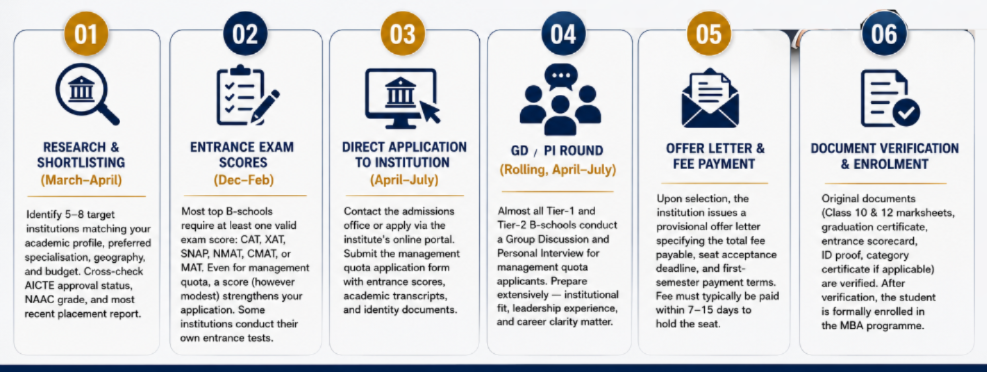
Step-by-Step Process for Securing Management Quota MBA Admission
The management quota admission process, while less regimented than state counselling, follows a broadly predictable sequence. Understanding each stage and preparing early dramatically increases the probability of securing a seat at your preferred institution.
Documents Required for Management Quota MBA Admission
- Class 10 mark sheet and certificate (SSC or equivalent)
- Class 12 mark sheet and certificate (HSC or equivalent)
- Graduation degree certificate and all semester mark sheets
- Valid entrance exam scorecard (CAT / XAT / SNAP / NMAT / CMAT / MAT)
- Passport-size photographs (typically 6–10 copies)
- Government-issued photo ID (Aadhaar, Passport, or Voter ID)
- Category/caste certificate (if claiming reservation under management quota — rare but applicable in some states)
- Migration certificate from previous institution
- Transfer certificate (TC) from undergraduate college
- Work experience certificate (if applicable — boosts profile)
- NRI/OCI status documents (for NRI quota applicants only)
Fee Structure & Cost Analysis
Fees are the most significant consideration for management quota applicants, and this section aims to demystify the cost architecture, helping families make accurate financial comparisons across institutions.
Components of the Total Fee
The fee payable under management quota is never simply “tuition fee.” It is a composite of several heads, some recurring annually and some one-time. A clear understanding of each prevents unpleasant surprises at the time of admission.
| Fee Component | Nature | Typical Range (₹) | Notes |
|---|---|---|---|
| Tuition Fee | Annual / Semester | ₹2.5L – ₹12L / year | Core academic instruction; higher for management quota than merit |
| Development / Infrastructure Fee | One-time or Annual | ₹50K – ₹3L | Often not prominently disclosed; verify at application stage |
| Library & Lab Fee | Annual | ₹15K – ₹50K | Usually included in tuition at top institutes |
| Hostel & Mess | Annual | ₹80K – ₹2L | Optional if day scholar; residential campuses may mandate |
| Alumni / Placement Fee | One-time | ₹20K – ₹1L | Levied at start of final year in many institutions |
| Exam / University Fee | Semester | ₹5K – ₹25K | Paid to affiliating university for exam conduct |
| Capitation / Donation Often Informal | One-time | ₹2L – ₹15L | Demanded by some institutions outside official receipts; legally prohibited under AICTE norms — students should demand official receipts for all payments |
Financing Management Quota Fees
The higher fee quantum of management quota seats need not be a deterrent for financially constrained but academically capable students. Several financing mechanisms are available:
➤ Education Loans: Nationalized banks (SBI, Bank of Baroda, Canara Bank) and private lenders (HDFC Credila, Avanse, Auxilo) offer collateral-free education loans up to ₹7.5 lakh, and secured loans up to ₹1–2 crore for AICTE-approved programmes. Interest rates range from 8.5% to 13% p.a., with repayment moratorium during study plus 12 months.
➤ NBFCs and Fintech Lenders: Institutions like Leap Finance, InCred, and GyanDhan specifically serve management quota applicants and can process loans in 7–10 working days — faster than bank timelines, crucial when seat acceptance windows are narrow.
➤ Institutional Scholarships: Many private B-schools offer merit-cum-means scholarships that are available even to management quota admits, typically awarded after the first semester performance review. These range from 10–30% fee waivers.
NRI Quota: Eligibility, Process, and Fee Implications
The NRI/OCI/PIO quota is a distinct category from management quota, though the two are often conflated. Understanding the differences is important for applicants and their families to identify which pathway they actually qualify for.
✅ Who Qualifies for NRI Quota?
Eligibility for NRI quota varies by institution, but typically includes:
- Indian citizens residing outside India for a continuous period (usually 2+ years) on a valid work/residence visa
- OCI (Overseas Citizen of India) cardholders of any nationality
- PIO (Persons of Indian Origin) cardholders
- Immediate relatives (spouse, children, siblings) of qualifying NRI/OCI/PIO, in some institutions
- Indian students whose parents are employed abroad and possess valid foreign employment documentation
✅ NRI Quota Fee: Conversion and Implications
NRI quota fees are often levied in US dollars, typically ranging from USD 8,000 to USD 25,000 per year at top private B-schools, equivalent to approximately ₹6.5L to ₹20L per year at current exchange rates. For some institutions, the NRI fee is expressed as a multiple of the merit fee (3× to 5×) in INR, making it potentially more expensive than management quota seats at the same institution.
However, NRI quota often offers a significant strategic advantage: entrance exam score requirements are frequently waived or significantly relaxed, and the quota operates independently from state counselling, giving NRI-eligible candidates direct access to seats at premium institutions without competing with the general merit pool.
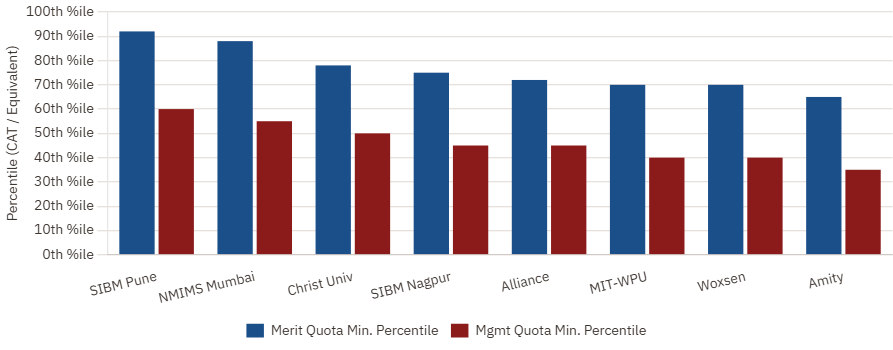
Minimum Entrance Score Requirements — Merit vs. Management Quota (Percentile), Top B-Schools Comparison
Is Management Quota Worth It? An Honest Return-on-Investment Analysis
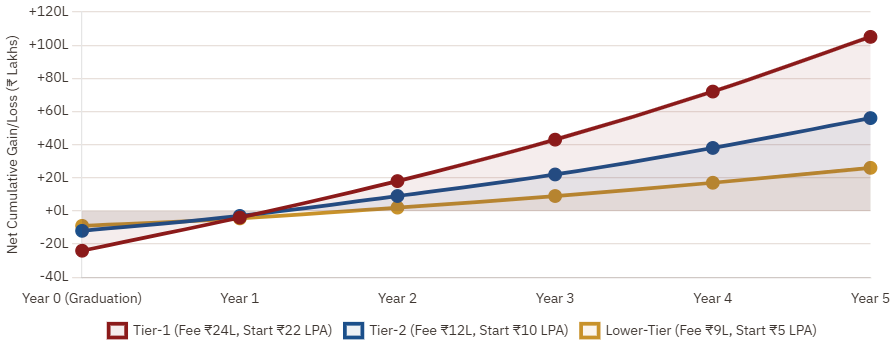
The question that every management quota aspirant and their family grapples with: Does the higher fee investment translate into commensurate career outcomes? The honest answer is nuanced — it depends critically on which institution you choose, the specialisation you pursue, and the effort you invest during the programme.
The Case For Management Quota
Brand Equity Matters More than the Admission Route: Employers and recruiters who visit campus for placements are generally agnostic about how a student secured their seat. A student admitted via management quota to SIBM Pune or NMIMS Mumbai walks out with exactly the same degree and brand name as a merit-admitted peer. The placement cell recruits from the entire batch, not from a selection of merit admits.
Time Cost of a Gap Year: For candidates who missed their target percentile by a narrow margin, the alternative — dropping a year, retaking CAT, and repeating the entire application cycle — carries an economic cost that, when properly calculated (one year’s foregone salary, test preparation expenses, opportunity cost), often rivals or exceeds the management quota premium.
Network and Peer Quality: Elite private B-schools attract strong peer cohorts regardless of admission route. The quality of the peer network — which is one of the most cited long-term benefits of an MBA — is driven by the institution, not the admission pathway.
The Risks to Acknowledge
Fee-to-Placement Ratio: The calculus breaks down at lower-tier institutions where management quota fees are ₹8–12L but average placement CTCs are only ₹4–6 LPA. In such cases, the loan repayment burden relative to starting salary creates significant financial stress. Strict due diligence on verified placement data (not brochure claims) is essential.
Credentialing Risk: A very small number of institutions have, in the past, admitted management quota students into programmes that subsequently lost AICTE approval mid-course. Always verify current AICTE approval on the official AICTE portal before paying fees.
ROI Analysis — Total Fee vs. 5-Year Cumulative Salary Projection (₹ Lakhs), Management Quota Admits
In-Demand MBA Specializations Available Under Management Quota in 2026
The MBA landscape in India has moved decisively beyond the Finance–Marketing binary. As industry demands evolve, top B-schools have added specialisations that command premium placements and are increasingly available as management quota options.
⬛ Finance & Banking
Remains the most competitive specialisation in terms of placement outcomes. MBA Finance admits — particularly from IIMs, NMIMS, and SIBM — are sought by Big 4 firms, investment banks, and fintech majors. Management quota finance admits who maintain a CGPA above 7.5/10 access identical recruitment cycles.
⬛ Business Analytics & Data Science (MBA + Tech)
The fastest-growing MBA specialisation in 2024–26, driven by demand from BFSI, e-commerce, and consulting. Institutions like Woxsen, Christ University, and Amity have introduced integrated MBA–Analytics tracks with industry-partnered curriculum. Management quota seats in this specialisation carry a premium of 10–15% over core MBA fees.
⬛ Marketing & Digital Marketing
Still a top-3 specialisation by enrolment volume. With the rise of D2C brands and performance marketing as a discipline, digital marketing specialisations at top B-schools now command ₹8–14 LPA starting offers — significantly up from ₹4–6 LPA five years ago.
⬛ Healthcare Management
A niche but high-growth specialisation, particularly relevant post-pandemic. Institutions like IIHMR Jaipur and Symbiosis Centre for Health Care offer dedicated healthcare MBA tracks. This specialisation sees limited competition in management quota, making it strategically advantageous for qualified aspirants from science backgrounds.
⬛ International Business
Available at institutions with global industry tie-ups (ITM Business School, Woxsen’s international cohort, FLAME University). Management quota admits in IB programmes often have access to overseas residency semesters and global placement drives, justifying the higher fee outlay.
MBA Management Quota Admissions — Answers to Key Queries
✅ Is management quota admission legal and recognized?
Yes, unequivocally. The Supreme Court of India (T.M.A. Pai Foundation v. State of Karnataka, 2002; P.A. Inamdar v. State of Maharashtra, 2005) has affirmed the right of unaided private institutions to admit students through their own process for a proportion of seats. Degrees awarded are identical regardless of admission route.
✅ Do I need a CAT/XAT score for management quota admission?
Most Tier-1 B-schools require at least a valid entrance exam score, though the minimum percentile threshold for management quota is significantly lower than merit quota (e.g., 50–60 percentile vs. 85–95 percentile for merit). Some Tier-2 and private universities accept MAT, ATMA, or their own entrance tests. A few institutions waive this requirement entirely for NRI quota.
✅ Can I get an education loan for management quota fees?
Yes. Education loans are available from nationalised banks, private banks, and NBFCs for AICTE-approved MBA programmes regardless of the admission route (merit or management quota). The loan amount, interest rate, and collateral requirement depend on the institution’s NIRF ranking and fee structure. Specialised education lenders like HDFC Credila and Avanse often process applications faster.
✅ What is the ideal timeline for applying under management quota?
Institutions begin releasing management quota seats typically from February–March onwards for July batch commencement. The window narrows significantly by May–June. Applying in April gives you the widest selection of seats. By July, most institutions have filled their management quota seats; late applicants find limited options at their preferred institutions.
✅ Are management quota MBA graduates treated differently by employers during placements?
No. Campus recruiters evaluate candidates on academic performance (CGPA), communication skills, domain knowledge, and cultural fit — not on their admission route. The placement cell operates without differentiation between merit and management quota admits. Post-admission academic performance is the primary determinant of placement outcomes.
✅ Can I change my specialization after taking a management quota seat?
Specialisation change policies vary by institution. At most B-schools, specialisation is declared at the time of admission or at the end of the first trimester/semester. Management quota admits are typically held to the same specialisation change rules as merit admits. Changing specialisation post-fee payment is generally possible only if seats are available in the desired track.
✅ What is the difference between management quota and NRI quota?
Management quota is open to all Indian applicants and is typically 15–25% of intake; NRI quota is reserved for NRI/OCI/PIO individuals or their relatives and constitutes 5–15% of intake. NRI quota fees are higher (often USD-denominated) but entrance score requirements are more relaxed or waived. A resident Indian applicant not qualifying as NRI/relative-of-NRI cannot apply under NRI quota.
✅ What happens if I pay fees and then want to withdraw?
AICTE’s Student Refund Policy mandates that institutions refund fees if a student withdraws before a specified cut-off date (usually before the commencement of the academic session), with only a processing fee deduction (₹1,000–₹5,000). After session commencement, pro-rata deductions apply. Always verify the institution’s refund policy in writing before paying management quota fees.
Also Read:
- Direct Admission in Top MBA Colleges in Indore 2026
- Direct Admission in Top MBA Colleges in Pune 2026
- Direct Admission in Top MBA Colleges in Delhi 2026
- Direct Admission in Top MBA Colleges in Hyderabad 2026
- PGDM Admission under Management Quota in India’s Top B-Schools
- Top MBA College Accepting SNAP Low Score Direct Admission
- Top MBA Colleges in Bangalore Accepting CAT Low Score 2026 Direct Admission
- Top MBA Colleges in Mumbai Accepting CAT 2026 score Direct Admission
- Top MBA Colleges in Delhi NCR Accepting CAT Low Score 2026 Direct Admission
- Direct MBA Admission without CAT
- List of MBA Colleges Accepting 50-70 Percentile CAT Get Direct Admission
- Top MBA Colleges Accepting 50-60 Percentile in CAT Exam- Direct Admission
- Top MBA Colleges Accepting 80-90 Percentile in CAT Exam- Direct Admission
- Low Rank/Score in CAT? Get Direct MBA Admissions in Top Colleges
- Top MBA Colleges Accepting 60-70 Percentile in CAT Exam Direct Admission
- Top MBA Colleges Accepting 70-80 Percentile CAT Exam- Direct Admission
- Direct Admission in Top MBA Colleges of Metropolitan City Delhi NCR
- Does ISB Hyderabad has Management Quota Seats
- Get Direct Admission in Symbiosis Pune
- Direct Admission in NMIMS Mumbai for MBA
- Welingkar Management Quota | Direct Admission | Call @ 9742479101
- Direct Admission in MDI Gurgoan Management Quota Seats
- Direct Admission in IMT Ghaziabad Low Score via Management Quota
- Direct Admission in Top MBA Colleges Across